
Top 5 Neckbands Under 2,000 Rupees: Big Sound, Small Price(India)

 Top 5 Neckbands Under 2,000 Rupees: Big Sound, Small Price


Neckbands are a fantastic way to enjoy music and calls on the go, without worrying about tangled wires. But with so many options under 2,000 rupees, choosing the right one can be overwhelming. Fear not, audio enthusiasts! Here's a breakdown of the top 5 neckbands, each with a highlighted feature to fit your needs:


1. Bass & Noise Cancellation King: The realme Buds Wireless 3 packs a punch with its 13.6mm Dynamic Bass Driver and boasts 30dB Active Noise Cancellation (ANC) for immersive listening. It also offers a massive 40 Hours Battery Life with fast charging, making it perfect for long journeys.


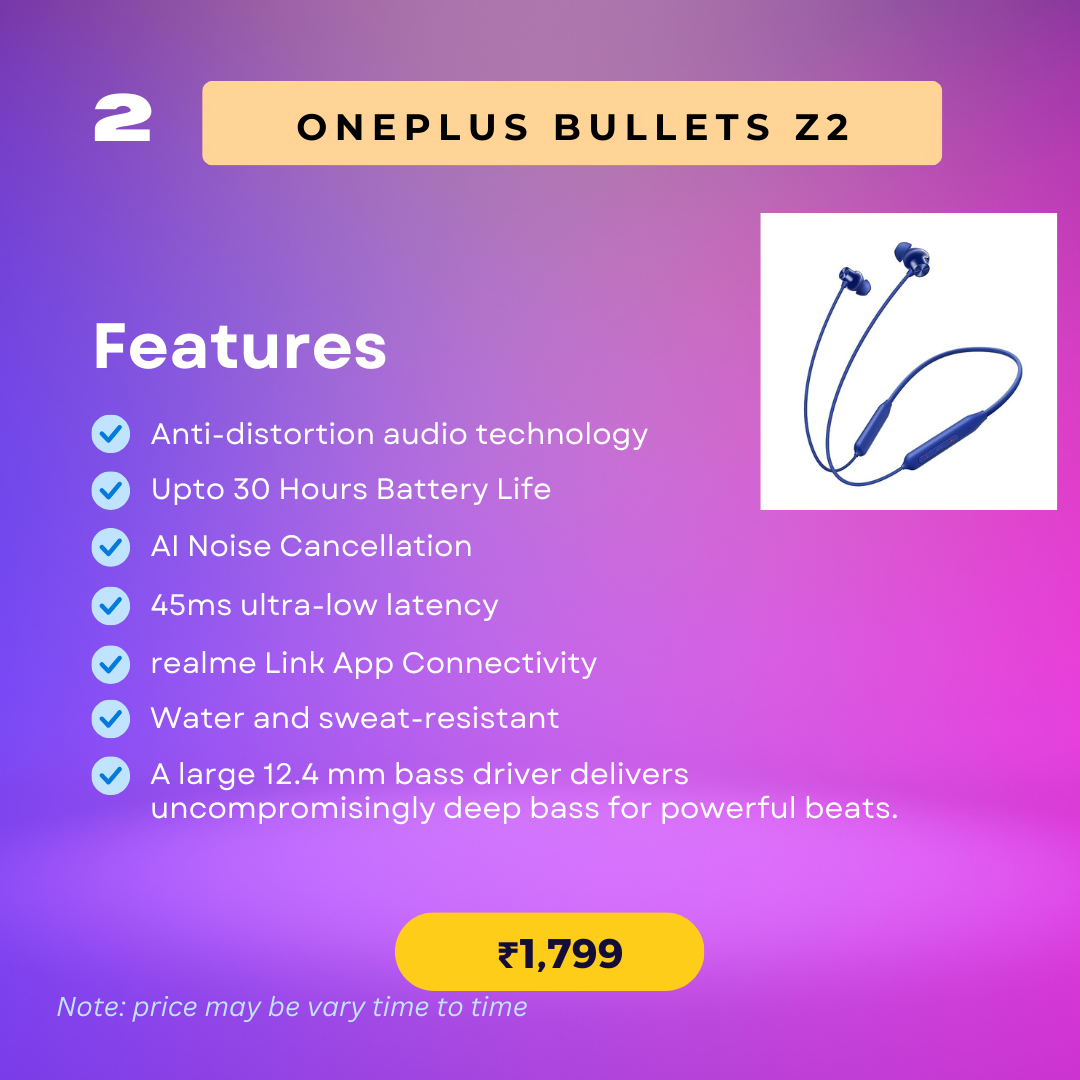
2. Fast Charging Champion: The OnePlus Bullets Z2 prioritizes quick charging, delivering 20 hours of playback with just a 10-minute charge. It features a large 12.4mm bass driver for deep sound and anti-distortion audio technology for clear highs. Plus, it's water and sweat resistant for worry-free workouts.


3. Crystal Clear Calls & Bass: The Oppo Enco M32 excels in call quality with its magnetic power control for easy on/off and super-fast charging (10 minutes for 20 hours playback). It also features a 10mm driver with a titanium-plated diaphragm for powerful bass and a secure, comfortable fit.


4. Marathon Playtime: The boAt Rockerz 330 Pro boasts a whopping 60 hours of battery life on a single charge.  ENx technology ensures clear calls, and ASAP Charge delivers 20 hours of playback in just 10 minutes.  10mm drivers and IPX5 water resistance make it a great all-rounder.


5. Dual Pairing & Powerful Bass: The Boult Audio ZCharge offers a 40-hour playtime, perfect for extended listening sessions. It features an ENC microphone for clear calls, dual device connectivity, and 14.2mm bass drivers for deep, rich sound. Plus, fast charging gets you back in the game quickly with just a 10-minute charge.


Choosing Your Perfect Neckband:

Consider your priorities! Do you crave deep bass, crystal clear calls, or a long-lasting battery for extended use? Once you know what matters most, you can pick the neckband that perfectly suits your music and calling needs.

Remember, this is just a starting point.  Researching online reviews and comparing features will help you find the ideal neckband under 2,000 rupees to elevate your audio experience.

All Products Buy Links - 

  1. realme Buds Wireless 3
  1. OnePlus Bullets Z2
  1. Oppo Enco M32
  1. boAt Rockerz 330 Pro
  1. Boult Audio ZCharge

Comments

Popular posts from this blog

What is power factor? Power factor formula

 What is power factor? Power factor formula In the study of electronics engineering, we often hear the term power factor. It plays an important role in understanding the efficiency of electrical circuits. Let us understand power factor in simple language in this blog post and also learn its formula. What is Power Factor? In simple words, power factor is the ratio of that part of the total current drawn by an electric circuit that is actually used to do useful work. We express it in percentage (%). High Power Factor: This is an ideal situation, where most of the current is used to do the actual work. It is considered to be between 90% to 100%. High power factor is an indicator of efficiency, which means less energy is wasted. Low Power Factor: This means that a large part of the current is being spent in generating reactive power in the circuit instead of doing actual work. This is a power factor of less than 80% and indicates inefficiency, leading to more energy being wasted. Power...

Basic Electronics quiz for beginner's

Question 1: In which year was the transistor invented? (a) 1947 (b) 1956 (c) 1960 (d) 1970 Question 2: How is rotational force generated in an electric motor? (a) Due to the electromagnetic field (b) Due to mechanical force (c) Due to gravitational force (d) Due to light energy Question 3: Which of the following is not an electrical appliance? (a) Fan (b) Fluorescent tube (c) Radio (d) Bicycle Question 4: Which device is used to convert solar energy into electrical energy? (a) Solar cell (b) Windmill (c) Generator (d) Battery Question 5: What is Ohm's Law? (a) V = IR (b) I = V/R (c) R = V/I (d) V = I^2R Question 6: What is the full form of LED? (a) Light Emitting Diode (b) Light Detecting Emitter (c) Light Energy Device (d) Light Amplifying Diode Question 7: Which of the following is not a semiconductor material? (a) Silicon (b) Germanium (c) Copper (d) Gallium Arsenide Question 8: On what principle does a transformer work? (a) Flow of electric current (b) Electric field (c) Induct...

Boost Your Confidence: 10 Essential Questions and Answers for Electronics Engineer Interviews

1. Explain the relationship between voltage, current, and resistance using Ohm's Law. Answer:  Ohm's Law states that the current (I) flowing through a conductor is directly proportional to the voltage (V) applied across it and inversely proportional to its resistance (R). This can be expressed mathematically as I = V / R. Understanding Ohm's Law is fundamental to analyzing and designing electronic circuits. 2. Differentiate between conductors, insulators, and semiconductors. Answer: Conductors:  Materials that readily allow electric current to flow through them due to loosely bound electrons. Examples include metals like copper and aluminum. Insulators:  Materials that strongly resist electric current flow due to tightly bound electrons. Examples include rubber, plastic, and glass. Semiconductors:  Materials with conductivity that falls between conductors and insulators. Their conductivity can be controlled by applying voltage or doping with impurities, making them c...